



Cosmetic otoplasty or ear cropping (partial or total removal of the ears) and caudectomy or tail docking (partial or total amputation of the tail) are surgical practices that have been used for centuries on certain breeds of dogs. Ear cropping is now prohibited in France, except when medically justified.
These surgeries raise questions about ethics and animal welfare. In this article, we examine what the law says about these practices and their consequences for the welfare and health of dogs.
Keep in mind
- Dog ear cropping is prohibited in France, while tail docking remains permitted but regulated.
- These procedures are not without risk to the animal's health and can have lifelong consequences.
- A dog's ears and tail play an essential role in its communication with other dogs. Cutting them off is depriving the dog of a means of expressing its emotions.
Ear cropping
What is ear cropping?
In dogs, ear cropping involves altering the appearance of the outer ear flap, usually by surgically removing up to half of it. After the surgery, the ears are bandaged and held in place with splints to promote healing in the desired shape. This procedure is generally performed when the puppy is between 9 and 12 weeks old. Most often, the dog is anesthetized before the procedure, and pain medication may be administered afterward, although it is not mandatory.

Historically, ear cropping was used in France to limit ear injuries during hunting or fighting. It could also be performed for aesthetic reasons and to meet the standards of certain breeds. Indeed, once cropped, the ears remain erect, giving the dog a more imposing appearance. This procedure was therefore particularly common among guard and working dogs for its intimidating effect. It has also been suggested that cropping the ears reduces the risk of infections by limiting moisture and dirt in the ear canal.
The effectiveness of ear cropping in preventing injuries or infections has not yet been demonstrated. The prevalence of ear infections, for example, in certain breeds of dogs with floppy ears, is thought to be more related to genetic predispositions within the breed, not ear shape[2].
Caudectomy
What is tail docking?
Caudectomy is the surgical removal of the distal portion (tip) of the tail. It is most often performed no later than five days after the puppy’s birth, which seems to limit pain, as the nerve tissue is not yet fully developed. The distal portion of the tail is removed with scissors or a scalpel, and the wound is then closed with one or more stitches.
Another method involves placing an elastic band around the tail, which cuts off circulation in the tissues and leads to necrosis and the tail falling off.

This practice was first used on hunting and fighting dogs to reduce the risk of tail injuries[3]. For hunting dogs operating in forests or thickets, an undocked tail could be scratched by brambles or barbed wire, resulting in wounds that would take time to heal. It is still practiced today on various breeds of hunting, working, and terrier dogs. For other breeds, tail docking is primarily performed for aesthetic reasons.
Today, these practices are governed by regulations aimed at limiting medically unjustified interventions.
From a legal point of view
Today in France, ear cropping for non-medical reasons is prohibited. This prohibition stems from the ratification and entry into force in 2004 of the European Convention for the Protection of Pet Animals of 13 November 1987[4].
Article 10 of this convention states that surgical interventions intended to alter the appearance of a pet or for other non-curative purposes must be prohibited and in particular:
- tail docking;
- ear cropping;
- severing of the vocal cords;
- removal of claws and teeth.
The exceptions to this article concern interventions deemed necessary by a veterinarian for medical reasons or for the welfare of the animal.
Ear cropping is prohibited in all European Union countries, as well as in Switzerland since 1981 and in the United Kingdom since 2006[5]. However, it is permitted or tolerated in other countries and remains practiced, notably in the United States.
With regard to tail docking, France has not ratified the relevant paragraph of the convention cited above. It is therefore still authorized[6].
However, some breed standards now prohibit this practice and no longer consider tail docking a criterion for conformation. This is the case for Rottweilers and Cane Corsos born after 2019, for which the French Société Centrale Canine no longer recognizes this criteria for breed confirmation examinations and dog shows. Seven other breeds, including the Boxer and the Doberman Pinscher, followed this trend in 2020.

Did you know?
A breed confirmation examination is an official evaluation conducted by a specialized judge, either as part of a competition or as part of registering a dog in the studbook, to verify that a dog conforms to the breed standards. This examination is generally performed on purebred dogs to confirm that they meet the standards established by breed clubs (size, weight, physical characteristics, behavior, etc.). To learn more, see our article on hypertype.
Tail docking must be performed by a veterinarian, as it is not included in the list of animal medical or surgical interventions that can be performed by non-veterinarians (Decree of October 5, 2011).
📌 Is tail docking painful?
There is still debate around the pain experienced by puppies during tail docking. Although it is difficult to objectively quantify the stress experienced by puppies during this operation, observations made during one study[7] suggest that they do experience pain during it.
However, another studye[8] concludes that, in puppies less than 7 days old, their brains are not yet developed enough for them to consciously feel pain during the procedure. Reactions, such as vocalizations, are likely due to automatic reflexes rather than a true perception of pain. This same study nevertheless indicates that docking a puppy’s tail in its first week of life may make it more sensitive to pain throughout its life, and may cause… chronic pain and distal portion hypersensitivity.
From a health perspective
Regarding ear cropping, the main health consequences are related to the surgical procedure itself. Ear removal requires general anesthesia, which can carry risks. After surgery, healing and manipulations such as bandaging or straightening the ears can be painful for several months. Complications, such as infections or deformities, can occur and may require further surgical interventions[9].
Regarding tail docking, some studies suggest that dogs with docked tails may have less developed pelvic floor muscles, but the evidence remains limited. Certain breeds in which tail docking is routinely performed show a higher incidence of incontinence, but this could also be influenced by other factors (sex, neutering, genetics)[10]. In some of these breeds, the levator ani muscle and coccygeal muscle (the muscle that allows the dog to tuck its tail between its hind legs) are also thought to be less developed[11]. Finally, since the tail plays a role in a dog’s balance, its amputation could impact its mobility.
From a behavioral point of view
Between dogs
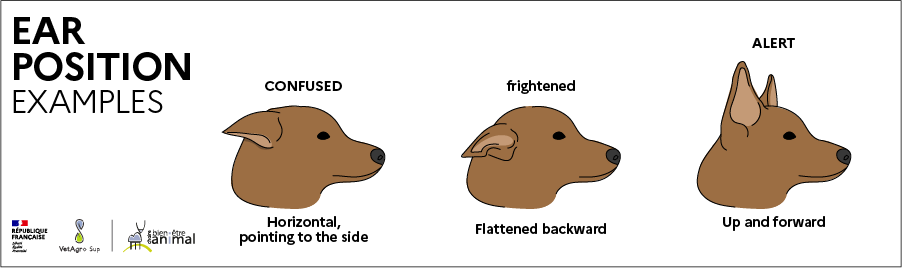
Part of canine communication involves the positioning of dogs’ ears. Indeed, dogs can express their emotional state, social status, or willingness to fight by using their ears[12]. Somehow like eyebrows in humans!
With its ears cut and erect, the dog is therefore deprived of part of its ways of communicating its emotions.
Dogs can fold their ears back to varying degrees depending on their level of excitement. Ears may be turned backward to express an intention to appease, or be completely flattened or pinned back (“seal ears”) in a frightened dog or in response to a conflict situation. Conversely, ears turned forward are associated with interest, attention, and an intention to approach, while a lateral ear position reflects a state of internal conflict[13].
Regarding tail docking, tail movements are essential in canine communication. They not only express the dog’s emotional state and intentions, but also play a key role in its interactions with other dogs.
Research has shown that the direction of tail wagging provides precise information. A dog that sees its owner, considered a positive stimulus, will tend to wag its tail more towards the owner. Tail wagging to the right indicates a desire to approach. Conversely, when faced with an unfamiliar dog perceived as a potential threat, a dog will wag its tail more to the left, indicating withdrawal or hesitation. Dogs themselves react to these differences. A dog that observes another dog wagging its tail primarily to the left, will show more stress signals – which are also accompanied by an increased heart rate. Certain tail positions may allow dogs to send appeasement signals to other dogs. Furthermore, tail wagging may sometimes help the dog calm itself.
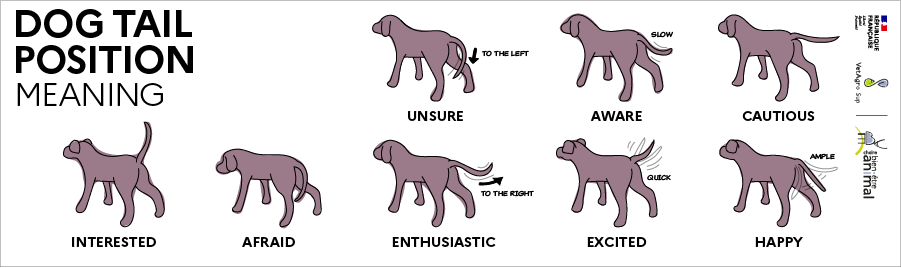
These elements underscore the importance of the tail in canine body language and highlight the consequences that tail docking can have on their intraspecific interactions and welfare. Tail docking can therefore alter dogs’ communication of intention and positive and negative emotions, which is essential for their welfare[14].
With humans
Ear and tail docking not only affect communication between dogs, but also influence how humans perceive dogs with cropped ears and/or tails. A study on approximately 400 people found that dogs with cropped ears and/or tails were perceived as more aggressive, more dominant, less playful, and less attractive than dogs that had not undergone these surgeries. This difference in perception may lead to differentiated treatment by humans[15].
Conclusion
In conclusion, although respectively prohibited and regulated, ear cropping and tail docking are still sometimes performed to the detriment of dogs’ health and welfare. These surgeries not only affect communication between dogs but could also alter human perception of these animals. The ban on tail docking is, in fact, among the key measures listed by the government in the French National Plan to Improve the Welfare of Domestic Animals, launched on May 22, 2024.
[1] Norris, L. J., Pinchbeck, G. L., Noble, P. J. M., & Radford, A. D. (2023). Dogs with cropped ears in the UK: a population‐based study using electronic health records. Veterinary Record, 192(5), no-no.
[2] Mills, K. E., von Keyserlingk, M. A., & Niel, L. (2016). A review of medically unnecessary surgeries in dogs and cats. Journal of the American Veterinary Medical Association, 248(2), 162-171.
[3] Houlton, J. E. F. (2008). A survey of gundog lameness and injuries in Great Britain in the shooting seasons 2005/2006 and 2006/2007. Veterinary and comparative Orthopaedics and Traumatology, 21(03), 231-237.
[4] Décret n° 2004-416 du 11 mai 2004 portant publication de la convention européenne pour la protection des animaux de compagnie
[6] Article R214-21 du Code rural et de la pêche maritime.
[7] Noonan, G. J., Rand, J. S., Blackshaw, J. K., & Priest, J. (1996). Behavioural observations of puppies undergoing tail docking. Applied Animal Behaviour Science, 49(4), 335-342.
[8] Mellor, D. J. (2018). Tail docking of canine puppies: Reassessment of the tail’s role in communication, the acute pain caused by docking and interpretation of behavioural responses. Animals, 8(6), 82.
[9] AVMA – Literature review on the welfare implications of ear cropping in dogs
[10] Holt, P. E., & Thrusfield, M. V. (1993). Association in bitches between breed, size, neutering and docking, and acquired urinary incontinence due to incompetence of the urethral sphincter mechanism. The Veterinary Record, 133(8), 177-180.
[11] AVMA – Literature review on the welfare implications of tail docking of dogs
[12] Packová, A., & Takáčová, D. (2020). Dogs health related to ear cropping. Folia Vet, 64(1), 77-82.
[13] Siniscalchi, M., d’Ingeo, S., Minunno, M., & Quaranta, A. (2018). Communication in dogs. Animals, 8(8), 131
[14] Mellor, D. J. (2018). Tail docking of canine puppies: Reassessment of the tail’s role in communication, the acute pain caused by docking and interpretation of behavioural responses. Animals, 8(6), 82.
[15] Mills, K. E., Robbins, J., & von Keyserlingk, M. A. (2016). Tail docking and ear cropping dogs: Public awareness and perceptions. PloS one, 11(6), e0158131.
Keep in mind
- Dog ear cropping is prohibited in France, while tail docking remains permitted but regulated.
- These procedures are not without risk to the animal's health and can have lifelong consequences.
- A dog's ears and tail play an essential role in its communication with other dogs. Cutting them off is depriving the dog of a means of expressing its emotions.
Key Figure
Date of ratification of the European Convention for the Protection of Pet Animals by France.


