



False...
But there is significant risk that they are! In cats, the mutation of the gene responsible for an entirely white coat also seems to affect several other characteristics, including the development of the inner ear and therefore hearing.
Keep in mind
- The completely white coat in cats is the result of a spontaneous mutation.
- A completely white cat has a significant risk of being deaf.
- The selection of breeding stock by breeders is crucial in order to avoid the risk of deafness.
In cats, entirely white coat[1] is the result of a dominant mutation identified in 2014. It is associated with other characteristics: pigmented irises (orange, yellow, or green), depigmented irises (i.e. blue – cats do not have red eyes), differentially pigmented irises (heterochromia or odd-colored eyes), and unpigmented skin resulting in pink nose tip and pink paw pads. This can affect both males and females.
Genetic basis
Genetic basis of entirely white coat
Basic genetics: a quick overview
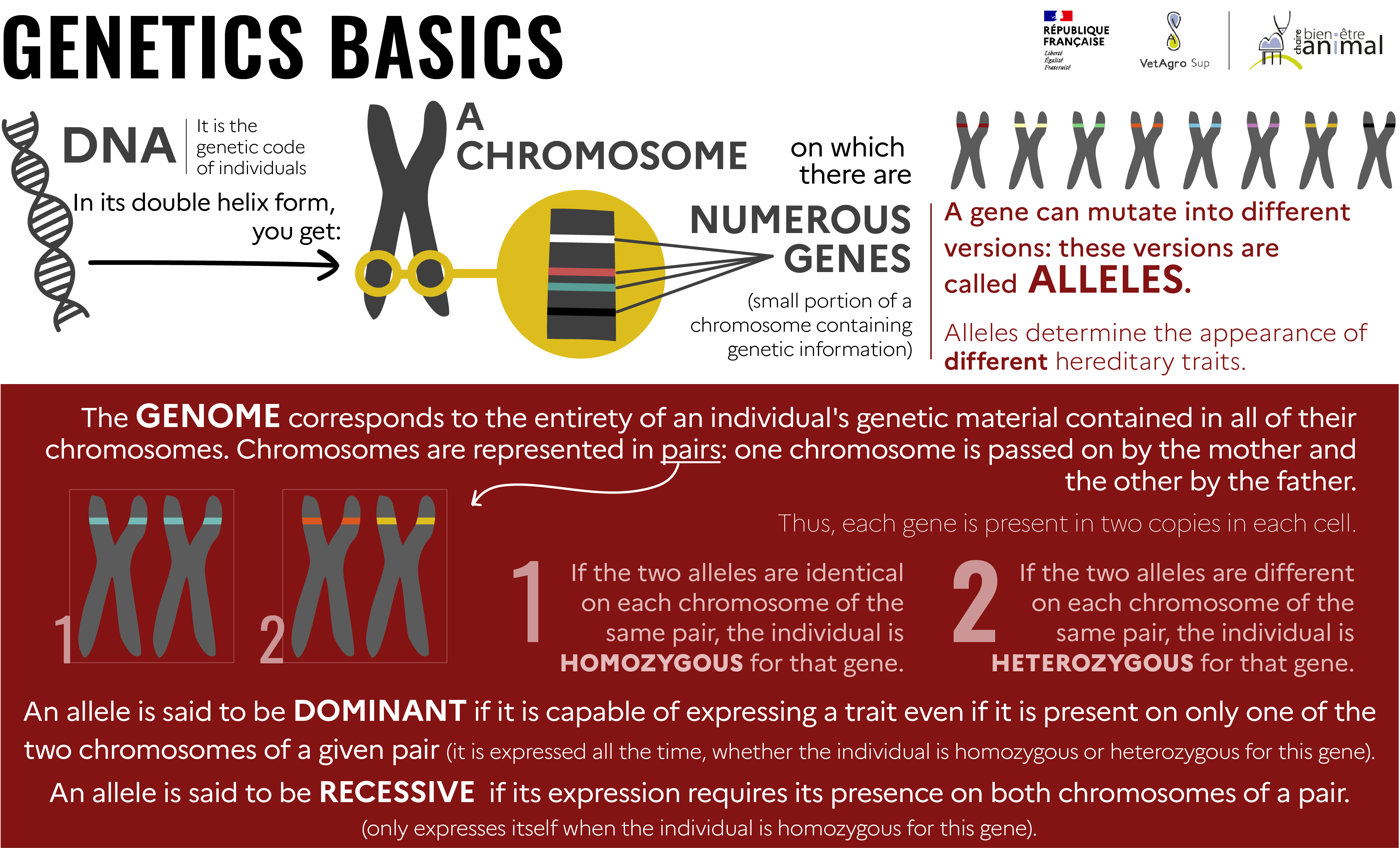
The cat’s genome consists of 38 chromosomes arranged in 19 pairs. As in humans (who have 46 chromosomes), each pair comprises one chromosome inherited from the mother and one from the father. Each gene is present in two copies in each cell, as it is located on each of the two chromosomes in a given pair.
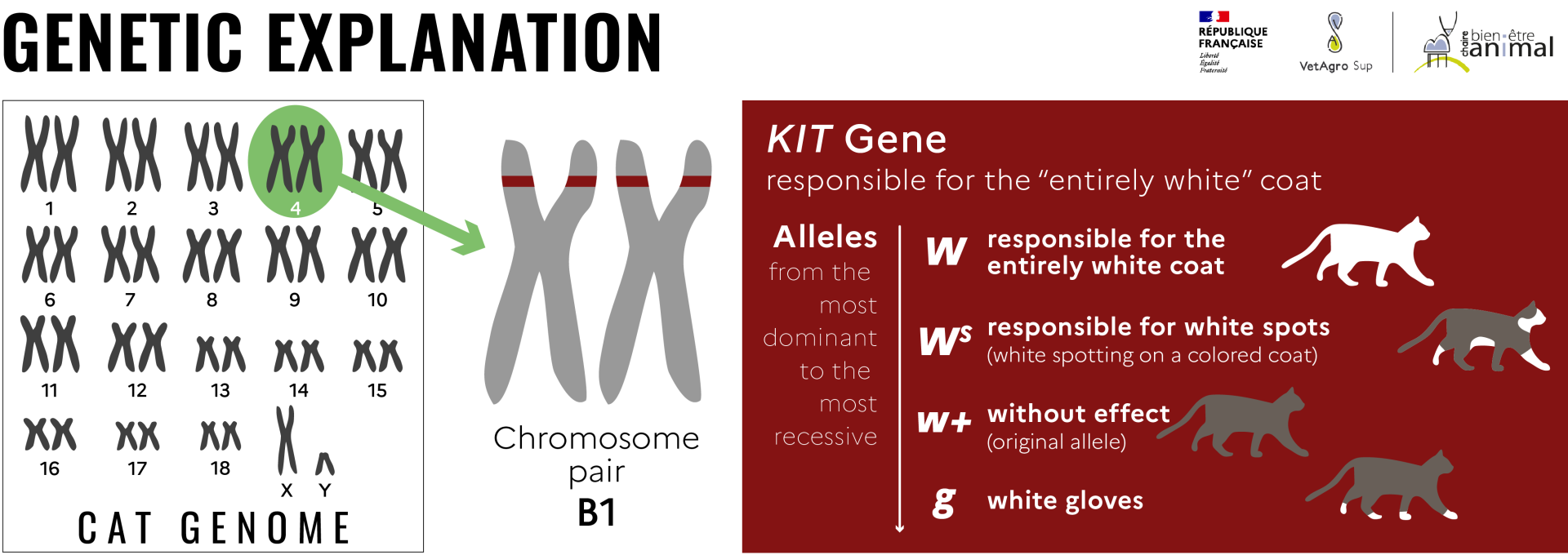
It is on the pair of chromosomes called B1, at the level of locus[2] W (White), that the gene responsible for the “completely white coat” trait was identified: it is the KIT (KIT Tyrosine Kinase) gene[3].
Several versions of this gene, called alleles, were identified by researchers[4] :
- The wild-type (ancestral) allele, designated w+, has no effect on coat color;
- The allele responsible for completely white coat, named W (White). The allele W is dominant over W S and w+.
- The allele responsible for white spots (white patches) on a colored coat, named W S (White spotting). The allele W S is dominant over w+.
- The allele named g, for gloves, has been associated with white gloves, particularly in the Birman cat. The g allele is recessive to all the other alleles mentioned.
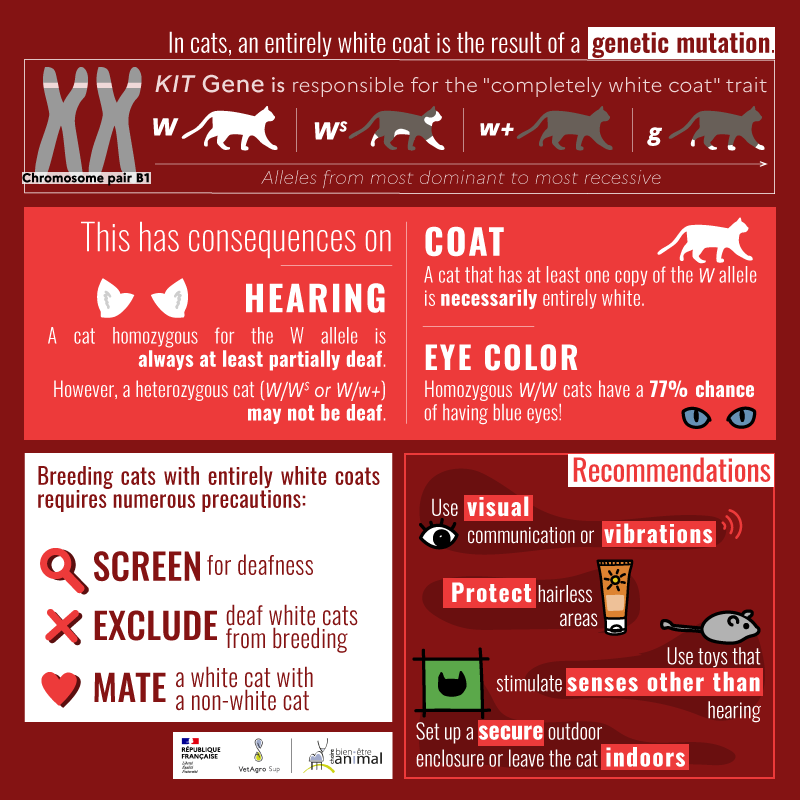
The W allele is described as ‘dominant with complete penetrance’: this means that when it is present, it overrides the other alleles and is consistently expressed. In other words, a cat that carries at least one copy of the W allele will necessarily be completely white. Conversely, any completely white cat must carry at least one W allele and, therefore, at least one of its parents is also completely white.

Did you know?
Mutation in the KIT gene leads to the appearance of depigmented patches in many species: horses, cows, pigs, and even humans. In humans, this results in localized bleaching of the scalp and therefore the formation of a streak of white hair: this is called piebaldism.
Mutations in the KIT gene alter the development, migration or survival of melanocytes, the cells specialized in the production of biological pigments (melanins), impacting in particular the color of skin and hair, but not only!
Consequences
One mutation, several consequences
On the coat[5]
A lack of pigmentation can have many causes, not all of which are due to a mutation in the KIT gene. Indeed, several stages of the development cycle of melanocytes (or their precursors, called melanoblasts) can be affected by genetic mutations: their multiplication, their migration in the body, their differentiation, their survival, or their melanin synthesis activity.
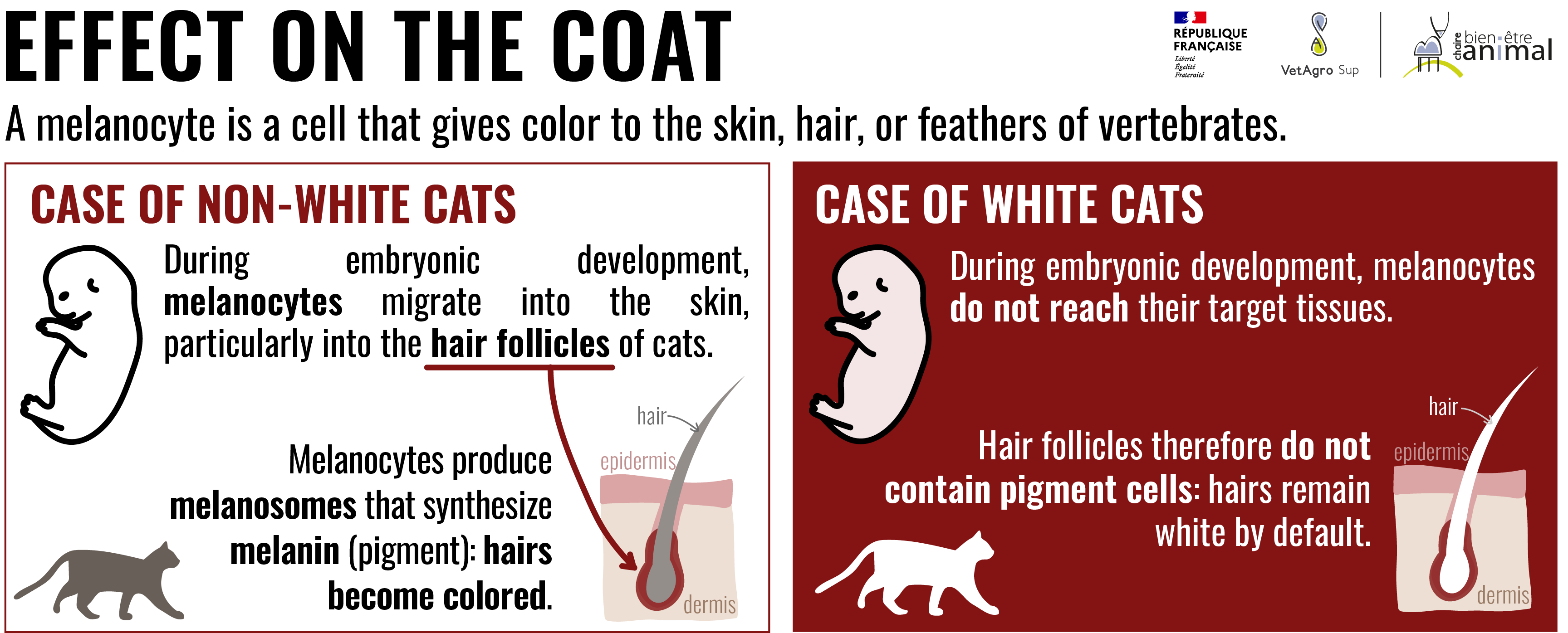
In the case of the dominant white coat in cats, the W mutation disrupts body colonization by pigment cells. In other words, melanocytes fail to reach their target tissues (such as skin) during embryonic development. Consequently, hair follicles do not contain pigment cells, hairs do not receive pigment and, by default, are white.
Did you know?
Melanin's function is, among other things, to protect the skin against ultraviolet radiation. Consequently, entirely white cats – whose epidermis lacks melanin – are 14 times more likely to develop UV-induced skin tumors in their hairless areas (ear edges, nose, etc.) than cats with colored skin[6].
But melanocytes are not only found in skin: these cells also play a role in the inner ear and the eye!
About hearing
Did you know?
The cat is an altricial mammal, meaning that its young are born unable to feed themselves or move independently. As a result, kittens are born deaf, but maturation of their auditory system occurs rapidly: it begins at the end of the first week of life and continues throughout the second week. Hearing thus becomes functional at around three weeks of age, on average.
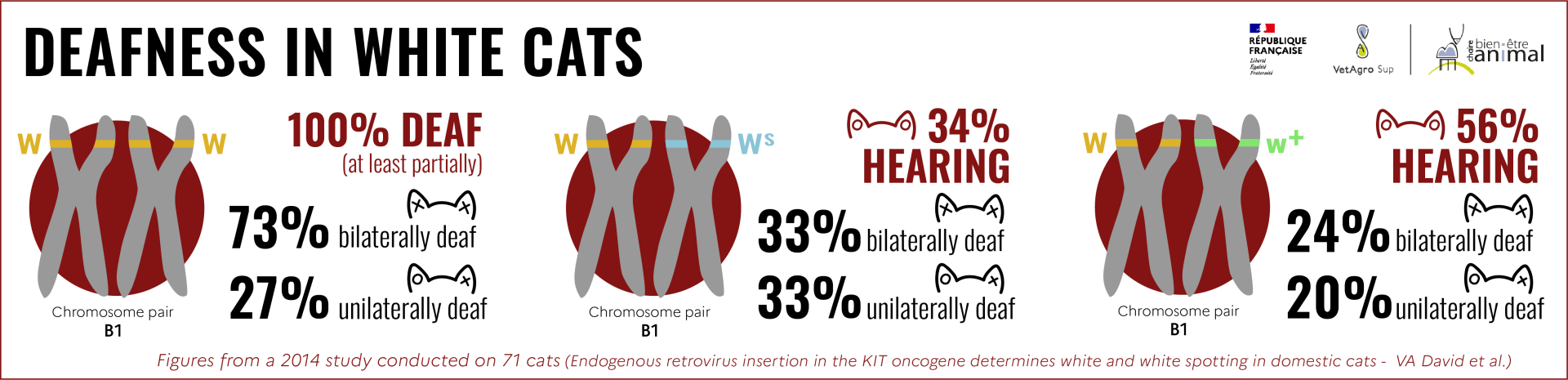
Unlike coat color, the penetrance of the W allele for deafness is not complete. This means that a cat heterozygous for the W allele (genotype W/w+) will be entirely white but may not be deaf[3]. A 2014 study on 71 cats found that:
- 22 homozygous W/W cats were at least partially deaf: 16 of them were bilaterally deaf, 6 unilaterally deaf;
- Heterozygous cats were partially deaf:
- 6 cats W/ W S: 2 of them were bilaterally deaf, 2 were unilaterally deaf.
- 25 W/w+ cats: 6 of them were bilaterally deaf, 5 unilaterally.
A third characteristic can also be impacted by the W mutation: the color of the cat’s iris.
Regarding eye color
Melanocytes also play a role in iris pigmentation. In cats, a lack of iris pigmentation results in a blue eye. A 2014 study showed that cats homozygous for the mutant W allele had a 77% chance of having blue eyes! As for heterozygous cats (W/w+), they were four times more likely to have blue eyes than all other cats[3]. This lack of iris pigmentation does not affect the cat’s visual abilities.
📌 Completely white cat vs albino cat?[8]
Albinism in cats is a rare phenomenon resulting from a mutation in a gene other than the KIT gene discussed here. Albinism affects the function of melanocytes at a different stage: the melanocytes are present in their target tissues, but it is the production of pigments that is impacted.
While the coat of an albino cat is the same as that of a completely white cat, the color of its eyes differs. Indeed, while white cats have colored eyes (green, yellow, or orange) or depigmented eyes (blue), albino cats have very pale blue eyes with a strong red tint and experience photophobia, or hypersensitivity to light. Unlike completely white cats, albino cats are not particularly at risk of developing deafness.
In summary, the gene responsible for the completely white coat in cats also encodes other traits, namely blue or odd-colored eyes and deafness. The W mutation of this gene is therefore described as pleiotropic, from the Greek pleion (‘more’) and tropē (‘change’), meaning that it determines multiple traits.
While the W allele shows complete penetrance for coat color – meaning that it is consistently expressed whenever it is present – this is not the case for deafness and iris pigmentation. As discussed above, all cats carrying a W allele are necessarily white, but they are not necessarily deaf and do not systematically have blue eyes. These two traits, although positively correlated with the presence of the W allele, appear to be modulated by the effects of other so-called modifier genes.
Breeding management adaptation
As you will have understood, breeding cats with a completely white coat requires a number of precautions.
The first is to prohibit matings between two white cats, in order to avoid the birth of white kittens that are homozygous for the W allele, which the 2014 study showed to be all at least partially deaf. This rule has been enforced by the LOOF (Livre Officiel des Origines Félines, the French Official Feline Pedigree Register) for several years. However, for cats which are not registered in this pedigree book, it is the responsibility of breeders and owners to ensure that this rule is respected.
To breed white cats while limiting the risk of deafness, it is recommended to:
- Screen white cats intended for breeding for deafness, even if they appear to have normal hearing, in order to detect unilateral deafness. This can be done using a clinical test measuring Auditory Evoked Potentials (AEPs), also known as the Brainstem Auditory Evoked Response (BAER) test;
- Exclude deaf white cats (unilaterally or bilaterally deaf) from breeding;
- Always mate a white cat (genotype W/w⁺ or W/Wˢ) with a non-white cat (which may nevertheless display white spotting or white gloves).

📌 Is a completely white coat in other animal species associated with the same consequences in terms of deafness?
Not always! When white coat is due to the same mechanisms as the W mutation – that is, an absence of pigment cells – there is a risk of deafness. However, when white coat is due to a defect in pigment synthesis, but the pigment cells are present, there is no associated deafness. This is the case with White Swiss Shepherd dogs, for example, which are genetically fawn-colored dogs, whose yellow pigment is extremely lightened to the point of becoming white!
Deaf cats welfare
Ensuring the welfare of deaf cats
Cats’ hearing range is very wide: they can detect a very broad frequency range extending from 45Hz to 65,000Hz[9] (compared to 20Hz to 20,000Hz for humans). Deafness is therefore particularly debilitating for cats, in several respects.
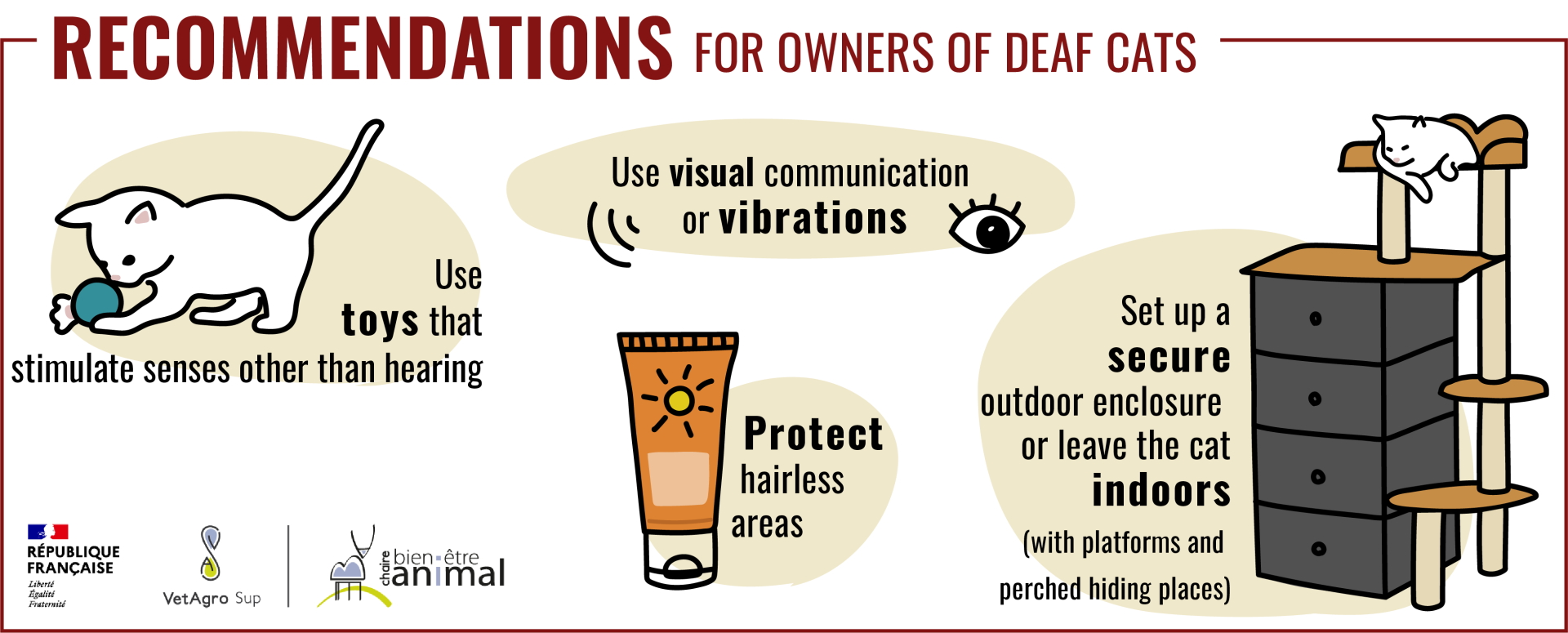
The cat is a hunter: in the wild, it eats about ten small prey items a day. To do so, it spends many hours each day hunting by ambush: motionless, it observes its surroundings, watching for the slightest movement or sound. It is capable of perceiving the ultrasonic sounds emitted by rodents, which are inaudible to humans. In a domestic setting, games can stimulate the cat and redirect its hunting instincts. In the case of a deaf cat, it is advisable to use toys daily that stimulate senses other than hearing: balls, laser pointers, etc.
While hearing is useful for hunting, it’s equally important for… not being hunted. By allowing the cat to detect other animals and surrounding dangers (dogs, cars, etc.), hearing is essential for ensuring its safety. For these reasons, it is not recommended to give a deaf cat free access to the outdoors. Several options are available: creating a secure outdoor enclosure where the cat can move freely, gradually accustoming it to going outside with a leash and harness, or keeping it indoors. In all cases, it is important to remember that cats particularly enjoy observing their surroundings from a height. It is therefore recommended to provide platforms and perched hiding places (high furniture, wall-mounted climbing structures, cat trees, etc.).
It’s also worth remembering that the hairless skin of white cats (ears, nose) is very sensitive to UV rays. Therefore, it is important to have these areas examined by a veterinarian during the annual check-up or as soon as unusual scabs or redness appear. The veterinarian can also recommend the use of sunscreen specifically designed for animals.
Finally, cats communicate with each other primarily through smell and pheromones (allomarking[10], scratching, urine spraying) and rarely use meowing. However, meowing is very common in cat-human interactions[11]. Furthermore, the meow of a domestic cat is shorter and higher-pitched than that of a wild cat, which humans generally find more pleasant[12]. But the differences don’t stop here: a 2011 study highlighted the fact that, while wild cats rarely meow and do so indifferently depending on the context, domestic cats only meow when a human approaches[13]! All of these results support the hypothesis that, through contact with humans, domestic cats have developed a specific language to more easily attract their attention. If the cat “talks” to humans, it has also developed an ability to understand them since it is able to recognize its name[14], and its master’s voice, or even tell whether the latter is speaking to it or not[15] !
Is vocal communication the most effective method? Not necessarily! In a 2023 study, French researchers demonstrated that cats respond preferentially to a visual or bimodal (visual + vocal) communication signal rather than a vocal signal alone. It therefore seems entirely possible to interact with cats in ways other than speaking to them: they are notably capable of learning the meaning of several gestures, including pointing gestures, and of following human gaze to obtain information[16]. They are also able to modulate their behavior based on human facial expressions of the humans – familiar or not – with whom they interact[17]. Vibrations can also be used to indicate to the cat that one is talking to it, all the while avoiding to startle it (tapping a surface with one’s fingers, walking heavily).
Conclusion
Completely white coat in cats is the result of a spontaneous mutation. The mutant allele, designated W, is dominant with complete penetrance for skin and hair pigmentation. This means that it is consistently expressed whenever it is present in a cat’s genome. In other words, any cat carrying at least one W allele is necessarily completely white.
This phenotype is, however, associated with other traits, such as eye depigmentation resulting in blue eyes, and deafness. The penetrance of these two traits is incomplete, meaning that their expression is modulated by other genes. Consequently, the selection of animals by breeders plays a crucial role in preventing the expression of deafness (whether unilateral or bilateral).
Some white cats are completely deaf. While the loss of hearing requires adapting our communication with cats – using visual or vibratory signals rather than vocal cues alone – the animal’s safety should be our primary concern. Lacking the ability to hear dangers (vehicles, dogs, etc.), a deaf cat is particularly vulnerable outdoors. It is therefore advisable to adapt their indoor living space to stimulate their natural hunting behavior with toys and hiding places, and/or to create a secure outdoor area.
In summary
Thank you to Marie Abitbol, veterinarian, teacher-researcher in genetics, consultant in preventive medicine at the veterinary school of Lyon (VetAgro Sup) and member of the scientific committee of the Central Canine Society and of the Official Book of Feline Origins for her review of the article.
[1] Please note that the coat may have a small pigmented area on the forehead when the kitten is born, but this disappears during the first few months of life.
[2] Cooper, M. P., Fretwell, N., Bailey, S. J., Lyons, L. A., 2006. White spotting in the domestic cat (Felis catus) maps near KIT on feline chromosome B1. Animal Genetics, 37, 2 : 163‑165. DOI : 10.1111/j.1365-2052.2005.01389.x.
[3] David, V. A., et al., 2014. Endogenous retrovirus insertion in the KIT oncogene determines white and white spotting in domestic cats. G3 (Bethesda, Md.), 4, 10 : 1881‑1891. DOI :10.1534/g3.114.013425.
[4] Montague, M. J., et al., 2014. Comparative analysis of the domestic cat genome reveals genetic signatures underlying feline biology and domestication. Proceedings of the National Academy of Sciences of the United States of America, 111, 48 : 17230‑17235. DOI :10.1073/pnas.1410083111.
[5] Roggy, J., 2021. Etude de la corrélation génotype-phénotype pour la panachure dans l’espèce féline. Thèse n°067, VetAgro sup
[6] Bensignor, E., Germain, P.-A., Gardini, F., 2014. Guide Pratique de Dermatologie du Chien et du Chat. Med’Com, Paris. 352 p
[7] Ryugo, D. K., Menotti-Raymond, M., 2012. Feline Deafness. The Veterinary clinics of North America. Small animal practice, 42, 6 : 1179‑1207. DOI : 10.1016/j.cvsm.2012.08.008.
[8] Abitbol, M., Bossé, P., Grimard, B., Martignat, L., Tiret, L., 2017. Allelic heterogeneity of albinism in the domestic cat. Animal Genetics, 48, 1 : 127‑128. DOI : 10.1111/age.12503.
[9] Strain, G. M., 2017. Hearing disorders in cats: Classification, pathology and diagnosis. Journal of Feline Medicine and Surgery, 19(3), 276-287.
[10] Cats leave scent messages for other cats when they rub against furniture, objects, or walls in their living space.
[11] Bradshaw, J., & Cameron-Beaumont, C., 2000. The signalling repertoire of the domestic cat and its undomesticated relatives. pp. 71-72
[12] Nicastro, N., 2004. Perceptual and Acoustic Evidence for Species-Level Differences in Meow Vocalizations by Domestic Cats (Felis catus) and African Wild Cats (Felis silvestris lybica). Journal of Comparative Psychology, 118(3), 287–296. https://doi.org/10.1037/0735-7036.118.3.287
[13] Yeon, S.C., Kim, Y.K., Park, S.J., Lee, S.S., Lee, S.Y., Suh, E.H., Houpt, K.A., Chang, H.H., Lee, H.C., Yang,B.G., Lee, H.J., 2011. Differences between vocalization evoked by social stimuli in feral cats and house cats. Behav Processes 87, 183–189. https://doi.org/10.1016/j.beproc.2011.03.003
[14] Saito, A., Shinozuka, K., Ito, Y., & Hasegawa, T., 2019. Domestic cats (Felis catus) discriminate their names from other words. Scientific Reports, 9(1), 5394. https://doi.org/10.1038/s41598-019-40616-4.
[15] De Mouzon, C., Gonthier, M., & Leboucher, G., 2023. Discrimination of cat-directed speech from human-directed speech in a population of indoor companion cats (Felis catus). Animal cognition, 26(2), 611-619. https://doi.org/10.1007/s10071-022-01674-w.
[16] De Mouzon, C., & Leboucher, G., 2023. Multimodal communication in the human–cat relationship: a pilot study. Animals, 13(9), 1528. https://doi.org/10.3390/ani13091528.
[17] Galvan, M., & Vonk, J., 2016. Man’s other best friend: domestic cats (F. silvestris catus) and their discrimination of human emotion cues. Animal Cognition, 19, 193-205.
Keep in mind
- The completely white coat in cats is the result of a spontaneous mutation.
- A completely white cat has a significant risk of being deaf.
- The selection of breeding stock by breeders is crucial in order to avoid the risk of deafness.
Key Figure
Probability of deafness in a homozygous W/W white cat


